


Abolitionist and Founder of UDC Predecessor Institutions
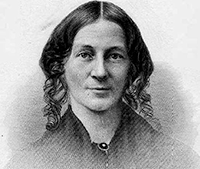 An iconic figure in the fight to educate African-American women, Myrtilla Miner stands as a reminder of the power of perseverance. Her efforts laid the foundation for what is today – the University of the District of Columbia.
Born March 4, 1815, in Brookfield, NY, Myrtilla Miner was one of 12 brothers and sisters. Miner and her rural family picked hops to try to make ends meet. A frail child, she spent her time absorbed in books and developed a love of learning. Despite her and her family’s enduring financial hardships, Miner was eventually able to earn her teaching degree from the Young Ladies’ Domestic Seminary, which had been founded in 1833 by the abolitionist Hiram H. Kellogg.
After earning her degree, Miner secured teaching positions in Rochester, NY, and Providence, RI, before moving to the South in 1846 to fulfill the obligations of her education—teaching plantation owners’ daughters in Whitesville, Mississippi, at the Newton Female Institute. It was there that she witnessed firsthand the horrors of slavery and vowed to teach the young slaves how to read. But her offer to conduct classes for them was refused, and was considered both illegal and immoral. Miner remained at the school for two years before suffering a serious illness that sent her back home with little chance of survival.
It was Miner’s deep determination to teach African Americans that helped her eventually recover from her illness. She began collecting funds to found a school, contacting Frederick Douglass, who was initially unsure about her prospects.
Frederick Douglass considered Miner’s proposal to be risky, stressing “the dangers she would encounter, the hardships she would have to endure and what seemed to me at the time certain failure of the enterprise after all she might do and suffer to make it successful.”
But Harriet Beecher Stowe, author of Uncle Tom’s Cabin, gave Miner $1,000 from the proceeds of her book to help establish a permanent location for the school.
Miner’s plans were met with heated opposition—harassment from mobs, physical violence and fire—in Washington, D.C., where slavery was still legal.
But in 1851, Miner began teaching six students in a small room, the children of freed slaves, which established the Normal School for Colored Girls. Miner’s goal was to teach them to be teachers themselves so they could elevate their population through education. Historian Constance Green noted that the school offered “a better education than that available to most white children.”
From the beginning of the school, Miner faced harassment targeted at the teachers and students. Mobs attempted to burn down Miner’s school. The school met with formal opposition from the white community and city leaders such as former Mayor Walter Lenox. On May 6, 1857, Lenox bitterly denounced Ms. Miner and her school in the National Intelligencer. Despite a constant barrage of bigotry, harassment, and threats of violence, Miner remained defiant and determined to teach African-American girls. In the end, she prevailed. One of her students remarked that she was “one of the bravest women I have ever known.”
By 1857, due to ill health, Miner had to step back from active involvement in the school, but by that time it was well established, with luminaries such as Johns Hopkins and Henry Ward Beecher serving on its board. However, Miner still found ways to continue her work and even helped put out a school fire from an arson attack in 1860.
Unfortunately, that same year Miner had to close down her school, but it later reopened after the Civil War.
On December 17, 1864, in Washington, D.C., Myrtilla Miner died from complications of a carriage accident. She had lived to see the Emancipation Proclamation come to fruition in 1863, but not the end of the Civil War. Her story would hardly be known if it had not been for a brief memoir of her life written by Ellen O’Connor in 1885.
Throughout the years, Miner’s school underwent numerous name changes and incorporation into other institutions, but it held the distinction of educating the majority of African-American elementary school teachers employed in the D.C. schools throughout World War II. The Miner Building is now part of Howard University’s School of Education. The university still has a small plaque there acknowledging Myrtilla Miner’s contributions.
Though her efforts to educate free African-American girls were a moderate and indirect approach to ending slavery, the University of the District of Columbia traces the history of public higher education for African Americans in the city to Myrtilla Miner’s School.
For more information, follow the link below: